Edit Your Video According to Script in Premiere Pro Using AI (No Manual Scrubbing Needed)
Learn how to use script-based editing in Premiere Pro with Premiere Assistant to automatically trim your video to match your script—no manual timeline edits needed.
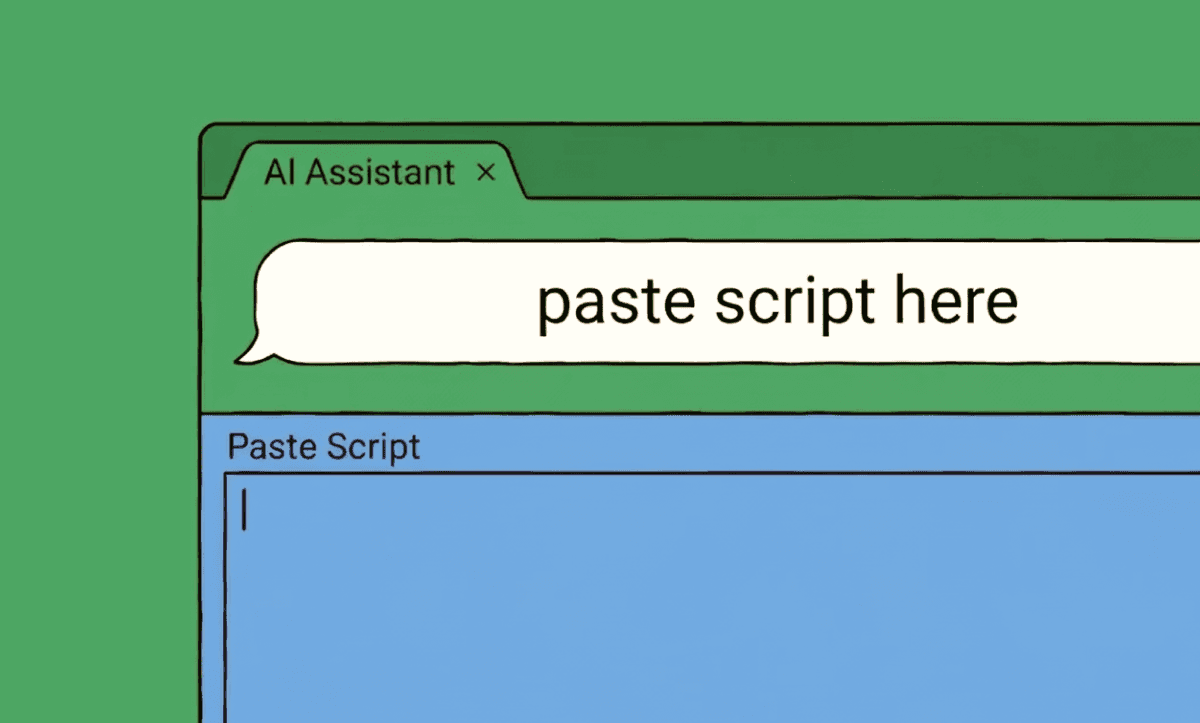
TLDR: Script-based editing in Premiere Pro works by importing a script into Premiere Assistant, which aligns it to your footage and lets you make cuts by editing the script text rather than scrubbing the timeline manually.
Why Script-Based Editing Changes Everything In Video Post-Production
If you've ever created a video that needed to follow a script, whether it's a YouTube explainer, a brand voiceover, or a narrative piece, you know how time-consuming it can be to manually scrub the timeline, trim clips, and sync the footage to your written content. Script-based editing flips that process on its head.
Instead of dragging clips around until they match your script, you can now turn your script into the edit guide itself. With Premiere Assistant’s AI-powered script-based editing tool inside Premiere Pro, the workflow is faster, smarter, and way less painful, ultimately giving you more time for creative video editing.
What is Script-Based Editing? How Is It Helpful For A Video Editor?
Script-based editing refers to a method of video editing where the final cut is guided by a written script. Instead of working from raw footage alone, the editor aligns each line of the video to match the original narrative plan. It’s especially useful for interviews, voiceovers, dialogue-heavy content, and educational material.
Traditionally, this would mean manually matching lines from a script to timestamps in the footage through timeline editing. With Premiere Assistant, it’s automatic. No more frame-by-frame editing. Paste in your script, and the AI matches it with the transcription from your video to make cuts for you.
How to Use Script-Based Editing with Premiere Assistant in Premiere Pro Video Plug-In
Step 1: Load Your Files Into Adobe Premiere Pro
Open a new Premiere Pro project and add your footage and audio to the timeline. Make sure your sequence is ready for editing.
Step 2: Launch Premiere Assistant
To install the Adobe Premiere Pro plugin, navigate to Window > Extensions > Cutback to open the plugin.
Step 3: Open Auto Rough Cut
From the Premiere Assistant interface, click on the Auto Rough Cut menu to access transcription and AI editing settings. From here, you’ll be able to access several time-saving editing tools and features.
Step 4: Configure Transcription Settings
Before the AI can match your script, it needs a speech-to-text transcription of your footage. To edit script, here's what you should set:
Range Selection: Choose whether you want to transcribe the full sequence, a selected clip, or in/out points.
Language: Select the spoken language in the footage.
Preview: Turn this on if you want to see the draft before applying it. (Optional)
Number of Speakers: Choose if there’s one speaker or multiple. Assign video tracks as needed.
Click Transcribe video for auto rough cut and let Premiere Assistant handle the transcription using its speech recognition engine.
Step 5: Launch Script-Based Editing
Once transcription is done:
Click the Assistant icon in the top-right.
Choose
Edit according to scriptfrom the chat UI.Paste your full script into the input box.
You’ll now get a choice to:
Stick to the script: AI will trim the video to strictly match the script, cutting out anything that wasn’t in the script.
Use the script as a rough guideline: AI will loosely align the edit with the script but may keep some relevant off-script parts if they help context or flow.
The assistant then generates a draft cut automatically, helping automate the workflow that would’ve taken you forever, otherwise.
Step 6: Review and Finalize
After the AI produces your script-matched cut, you can:
Click
Select best cutto review and choose preferred takes.Click
Saveto confirm.Click
Apply to sequenceto push those changes to your Premiere timeline.
Script-based editing is truly a lifesaver (regardless of the software you use) when it comes to repetitive tasks automation in your professional video editing journey.
Other Premiere Assistant Features You Can Use With Script-Based Editing
Premiere Assistant works best when used alongside other automation tools for creators. Here’s what else you can use to improve your workflow:
Remove Retakes: Automatically delete repeated takes and make your best takes selection easier.
Remove Silences: Use an AI silence remover to tighten your video by trimming unnecessary pauses.
Caption features: Generate animated captions with caption presets and translate captions to reach global audiences more easily.
Auto Multi-cam Editing: Sync and edit multi-camera content using voice recognition and easy multi-cam switching.
Shorten Video: Instant video shortening through AI-powered trimming to create more impactful edits.
Creative features: Jazz up your videos through built-in B-roll search, animation features, edit photos, and more.
These tools can be layered together in a single workflow to drastically speed up your post-production.
Smart AI Features to Know For Video Editing Automation
Time Machine: Revert your project to before you applied any changes.
Find & Replace: Useful for updating names or terms in your subtitles.
Smart Summary: Skip to any chapter or section of your video using the generated summary.
Keyboard Shortcuts: Speed up your navigation and edits using intuitive shortcuts like:
w a s dto movekto cut at wordlto cut at sentenceShift + .orShift + ,to speed up or slow down the preview
Use Cases for Script-Based Editing For Intelligent Video Editing
Tutorial Creators: Follow your teaching script without missing points.
Podcasters & Interviews: Match spoken dialogue to planned scripts or talking points.
UGC Creators & Brands: Maintain brand voice across short-form video content.
Faceless Video Creators: Align AI-generated voiceovers to your visual timeline.
No matter your niche, if you're working from a script, Premiere Assistant can cut down your edit time dramatically and unlock a new level of video editing productivity.
For more in-depth knowledge about the ins and outs of video editing, check out our latest posts on the Cutback blog or our YouTube channel.
Frequently Asked Questions
Q: Can I reload a script if I close the project?
A: Yes. Your transcription and script data are saved per sequence, and you can reload them from the Premiere Assistant panel.
Q: Will my previous subtitles be deleted?
A: Only if you select “Generate New Subtitle.” Always use “Open Previous Work” to preserve edits.
Q: Why is my Apply button grayed out?
A: This means no edits have been made yet. Once you trim or delete content, the button activates.
Q: Can I use both script-based and text-based editing together?
A: Absolutely. Start with your script, then use the transcription view to refine or tweak individual words or sections.
Q: What if I don’t like the AI’s cut?
A: You can discard the draft, try a new prompt, or give clearer instructions via the chat UI.
Q: What is text-based editing in Premiere Pro?
A: Text-based editing in Premiere Pro is the method of cutting footage by working directly from a transcript rather than scrubbing the timeline. After transcribing your sequence, the transcript appears in the Text panel where you can select, delete, or rearrange words and sentences, Premiere Pro removes or repositions the corresponding footage on the timeline automatically. Premiere Assistant's text-based editing goes further than Premiere Pro's native tool by adding chapter navigation, speaker labels, script matching, Find and Replace in subtitles, and a chat interface for natural language editing commands.
Q: How do you do text-based editing in Premiere Pro?
A: Transcribe your sequence first via Window > Text > Transcribe Sequence. Once complete, the Transcript tab shows a word-level transcript synced to your footage. Click any word to jump the playhead to that moment. Select a word or section and press Delete to remove the corresponding footage from the timeline with a ripple delete. For AI-assisted text-based editing with script matching and chat commands, open Premiere Assistant (Window > Extensions > Cutback), run the Auto Rough Cut transcription, then use the Assistant chat to type editing instructions or paste in a script for the Edit According to Script function.
Q: How do I edit a transcript in Premiere Pro?
A: In Premiere Pro's native Text panel, click any word in the transcript to move the playhead to that position. Select text segments and delete them to remove the corresponding footage. To edit the transcript text itself (correct a misheard word or fix speaker label), click directly on the word and type your correction. In Premiere Assistant, the transcript editor supports chapter-level navigation, speaker name editing, Find and Replace across all subtitles, and keyword search to locate specific content without scrubbing.
Q: How do I edit video according to a script in Premiere Pro?
A: In Premiere Assistant, open Auto Rough Cut, transcribe your sequence, then click the Assistant button and choose Edit According to Script. Paste your script into the input field and choose how strictly the AI should follow it, strict matching removes everything not in the script, while loose matching retains contextually relevant off-script content. Premiere Assistant aligns each script line to the transcript, removes takes that do not match, and generates a draft rough cut automatically. From there you can review, select the best cut, and apply to the sequence.
Q: Is there an open-source script-based editing tool for Premiere Pro?
A: There is no widely-used open-source script-based editing plugin for Premiere Pro. Community projects and GitHub repositories exist for basic transcript processing scripts but none provide the full script-matching and AI rough cut functionality of Premiere Assistant. Premiere Assistant is currently the most complete implementation of script-based editing inside Premiere Pro, using its own speech-to-text engine alongside the script-matching workflow.
Q: How do I change the duration of text in Premiere Pro?
A: For captions and subtitles generated by Premiere Assistant, open the caption segment in the timeline and drag the edges to adjust the duration, or use the Effect Controls panel to set precise in/out points. For title and graphic text created with the Essential Graphics panel (Titles tool), select the clip in the timeline and drag its edges to extend or shorten the duration. For static text, duration is set by the clip length. For animated text using a Motion Graphics Template (MOGRT), the duration is controlled by the clip length in the timeline, stretch or compress it to adjust how long the animation plays.
Q: How do I edit text in Premiere Pro Essential Graphics?
A: Select a text clip on the timeline, open the Essential Graphics panel (Window > Essential Graphics), and click the Edit tab. Click directly on the text in the Program Monitor to enter text-editing mode and retype content. Font, size, colour, tracking, and alignment are all adjustable from the Essential Graphics panel. For captions generated by Premiere Assistant, they use native Premiere Pro graphic clips rather than Essential Graphics templates, which means they render significantly faster, adjust their text directly in the caption editor panel or by double-clicking the caption segment in the timeline.

Cutback Team
Share post