Master Text-Based Video Editing with AI in Premiere Pro With This Workflow
Learn how to speed up your workflow with text-based video editing using Premiere Assistant's AI transcription in Premiere Pro. Edit like a doc, cut like a pro.
TLDR: Text-based editing in Premiere Pro works by transcribing your sequence, then cutting directly from the transcript; deleting words removes the corresponding footage, making dialogue-heavy edits significantly faster than scrubbing the timeline.
Text-based video editing lets you skip the timeline scrubbing and jump straight to the point, literally. Instead of hunting through audio waveforms to cut filler, you just read the transcription and make edits like you’re working in a doc.
With Premiere Assistant, you can do this directly inside Adobe Premiere Pro. Our AI transcription engine lets you generate subtitles, edit video through text, and instantly remove awkward pauses, filler words, or retakes, without ever touching the timeline.
Let’s break down how it works and how you can speed up your post-production flow.
What Is Text-Based Editing?
Text-based editing is exactly what it sounds like: editing your video through the transcript. Once your footage is transcribed, you can delete words, sentences, or even whole chapters by simply selecting the text.
Instead of jumping around your timeline and scrubbing through takes, you get a clean, readable script where every word is synced to its corresponding clip.
How To Use Text-Based Editing in Premiere Assistant
1. Transcribe Your Video
Start by launching Premiere Assistant in Premiere Pro via Window > Extensions > Cutback. Then select Auto Rough Cut.
Choose the appropriate settings:
Range: Whole sequence, selected clips, or in/out points
Language: Select the spoken language
Speakers: Indicate if it's one person, multiple, or audio-separated tracks
Names/Keywords: Add key terms or script references to improve accuracy
Then click [Transcribe video for auto rough cut].
2. Edit by Text, Not Timeline
Once transcribed, your video appears as readable text. You can:
Delete a chapter with one click
Remove a sentence using the scissors icon or shortcut l
Delete a word by selecting it and hitting k or using the right-click menu
All edits are shown in gray. They don’t affect your timeline until applied, giving you room to review and revise.
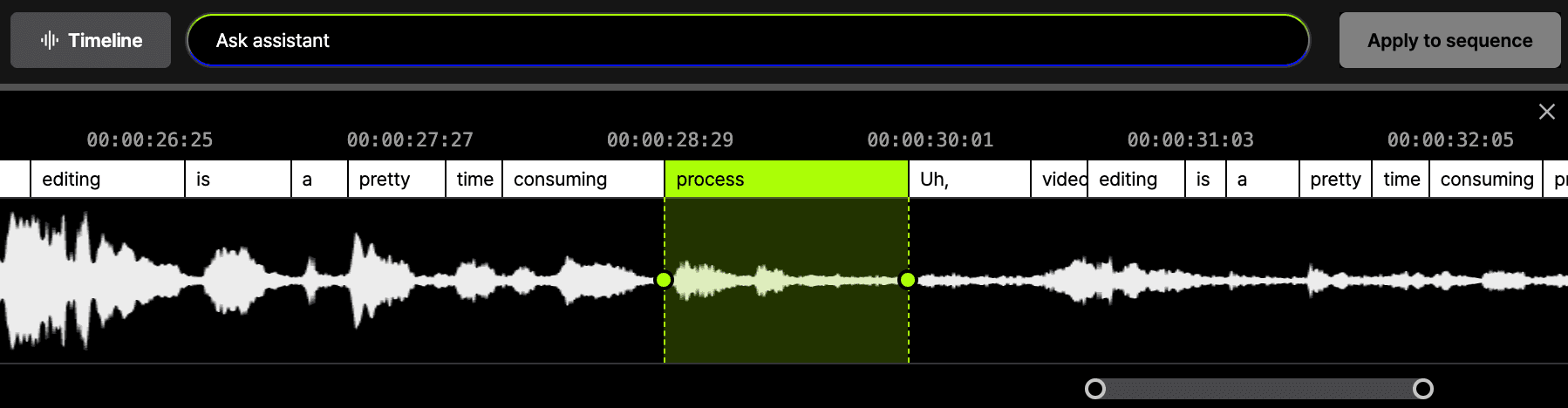
3. Use Timeline View for Fine Control
Want to be more precise? Click the Timeline button to switch views. Here, you can fine-tune clips just like a standard editor while still leveraging the transcript.
4. Apply Your Changes
When you’re ready, hit Apply to sequence to lock in the changes. You can choose to overwrite your current sequence or create a new one.
Bonus: Smart AI Features That Save Time
Text-based editing is just the start. Here are a few productivity boosts you’ll unlock inside Premiere Assistant:
Zoom Effects: Highlight key moments by selecting text and applying animated zoom
B-Roll Overlay: Add video, images, or GIFs to match lines of dialogue
Find + Replace: Quickly swap words or phrases across the transcript
Time Machine: Instantly roll back if you don’t like the result
Export Options: Get .srt, .txt, or timestamped summaries for YouTube chapters
FAQs About Text-Based Editing With Premiere Assistant
Subtitle track blocking cuts? Delete all “Captions” tracks from the sequence
Can’t apply changes? You need to make at least one cut for the Apply button to activate
Out-of-sync subtitles? Avoid editing your timeline after applying rough cuts unless you're completely done
Slow processing? Remove unused tracks, effects, and work in shorter sequences
Final Thoughts
Text-based editing isn’t just a cool feature; it’s a smarter workflow. You read your edits, cut what you don’t need, and move faster. Whether you're editing interviews, educational videos, or social media content, Premiere Assistant’s transcription-powered editing helps you move at 10x speed, without compromising quality.
For more in-depth knowledge about the ins and outs of video editing, check out our latest posts on the Cutback blog or our YouTube channel.
FAQs (Frequently Asked Questions)
Q: What is text-based editing in video?
A: Text-based editing is the process of cutting video by working with a transcript instead of the timeline, once your footage is transcribed, deleting a word, sentence, or chapter in the text removes the corresponding footage automatically. It replaces timeline scrubbing with reading, which is significantly faster for dialogue-heavy content like interviews, podcasts, and tutorials where the editorial decisions are primarily about content rather than visual composition.
Q: How do you use text-based editing in Premiere Pro?
A: Using Premiere Assistant: open the plugin via Window > Extensions > Cutback, select Auto Rough Cut, configure your range, language, and speaker settings, then click Transcribe Video for Auto Rough Cut. Once transcribed, delete unwanted chapters, sentences, or words directly in the transcript view, edits appear in gray for review before being applied. Click Apply to Sequence when ready. Using Premiere Pro's native tool: go to Window > Text > Transcribe Sequence, then click on words in the Text panel to delete the corresponding footage.
Q: Does text-based editing work in DaVinci Resolve?
A: DaVinci Resolve does not have a native text-based editing feature comparable to Premiere Pro's transcript-driven cutting. The closest equivalent is using markers and the transcript from DaVinci Resolve's AI Transcription tool (DaVinci Resolve 20) for navigation, though it does not support cutting by deleting transcript text directly. For text-based editing before footage reaches DaVinci Resolve, Selects transcribes your footage and lets you cut by selecting transcript sections, then exports a native DaVinci Resolve timeline with those cuts already applied.
Q: Does text-based editing work in Final Cut Pro?
A: Final Cut Pro does not have native text-based editing built into its core toolset. Editors typically rely on Smart Collections, keywords, and the standard timeline for navigation rather than transcript-driven cutting. Selects provides a text-based editing workflow upstream of Final Cut Pro, it transcribes your footage, lets you cut by reading and selecting transcript sections, and exports a native Final Cut Pro XML with the cuts already applied.
Q: How is text-based editing in Premiere Pro different from CapCut?
A: CapCut offers transcript-based editing on both mobile and desktop, letting you delete words from a transcript similar to Premiere Pro's approach. The key difference is environment: CapCut operates as a standalone app outside a professional NLE, which is faster to learn but limited in audio mixing, color grading, and multi-track complexity. Premiere Assistant's text-based editing happens inside Premiere Pro, so the cuts you make integrate directly with your existing color work, audio mix, and multicam setup without an export-reimport cycle.
Q: Is text-based editing free in Premiere Pro?
A: Premiere Pro's native text-based editing (via the Text panel and Transcribe Sequence) is included with a Creative Cloud subscription at no additional cost. Premiere Assistant's enhanced text-based editing, which adds chapter-level navigation, Find and Replace, Time Machine rollback, B-roll insertion from text, and zoom effects, requires a paid plan after a trial period with limited usage.
Q: Did Premiere Pro 2020 have auto transcribe or text-based editing?
A: No. Adobe added native Speech to Text transcription and text-based editing to Premiere Pro starting with the 22.0 release in late 2021, not in the 2020 version. Editors using Premiere Pro 2020 needed third-party transcription tools or manual timeline editing, since the native transcript-driven workflow did not exist yet. Current versions of Premiere Pro all include native transcription; Premiere Assistant extends it further with broader language support and chapter-based navigation.

Cutback Team
Share post