Assembly Cut vs. Rough Cut: What’s The Difference And Why It Matters For Your Workflow
The assembly cut and rough cut are two distinct editing stages. Here's what separates them, where the paper cut fits in, and how Selects automates the assembly automatically.
TLDR: The assembly cut is the first full pass of all usable footage with no creative decisions, the rough cut is where story decisions begin, and Selects automates the assembly stage entirely.
Most editors use "assembly cut" and "rough cut" interchangeably. They're not the same thing. The distinction matters because each stage has a different purpose, a different standard, and a different cost in time, and confusing them is one of the main reasons the early stages of editing take longer than they should.
For a full reference on editing terminology, the video editing glossary for 2026 covers every stage of the post-production process.
What Is an Assembly Cut?
The assembly cut is the first complete pass of a project. Every usable take is laid down in sequence order; nothing is trimmed for story, nothing is cut for pace, and no creative decisions are made. The goal is simply to have all the material in one place in a workable order.
Think of it as the raw inventory of your edit. An assembly cut for a one-hour interview might run two hours or more. That's expected. The assembly cut is not supposed to be good; it's supposed to be complete.
What goes into an assembly cut:
Every selected take in sequence, including alternates
Synced multicam footage laid across tracks
Basic labeling by speaker, topic, or scene
Nothing removed except clearly unusable material (dead air, technical failures)
The assembly cut is a structural starting point, not a storytelling decision. No judgments about what works yet, just organization.
Does the Assembly Cut Include Sound and Music?
How close to the final cut does an assembly cut have to be? The assembly cut uses production audio only, no score, no sound design, no mixing. Sound decisions come in the rough cut and beyond.
How Long Does an Assembly Cut Typically Run?
How long an assembly cut runs depends on the length of the raw footage and the intent of the video project. For instance, for a corporate marketing video edit or interview content, the assembly cut typically runs 2-3 times longer than the final cut. This gives the next video editor leeway to choose the best shots and rearrange them.
What Is a Rough Cut?
The video rough cut definition varies depending on which video editor you ask, but the rough cut is where editing actually begins. Starting from the assembly, the editor makes the first round of story decisions, what stays, what goes, what order serves the narrative. Sections are trimmed. Redundant content is removed. The structure of the final piece starts to take shape.
A rough cut is still imperfect by design, pacing may be loose, transitions unfinished, and audio unpolished. But it reflects creative intent. You can watch a rough cut and understand what the final video is trying to do.
The gap between assembly cut and rough cut is where most of the editorial judgment lives. It's also where most editors want to spend their time. The problem is getting there.
What Comes Before the Rough Cut and What Comes After?
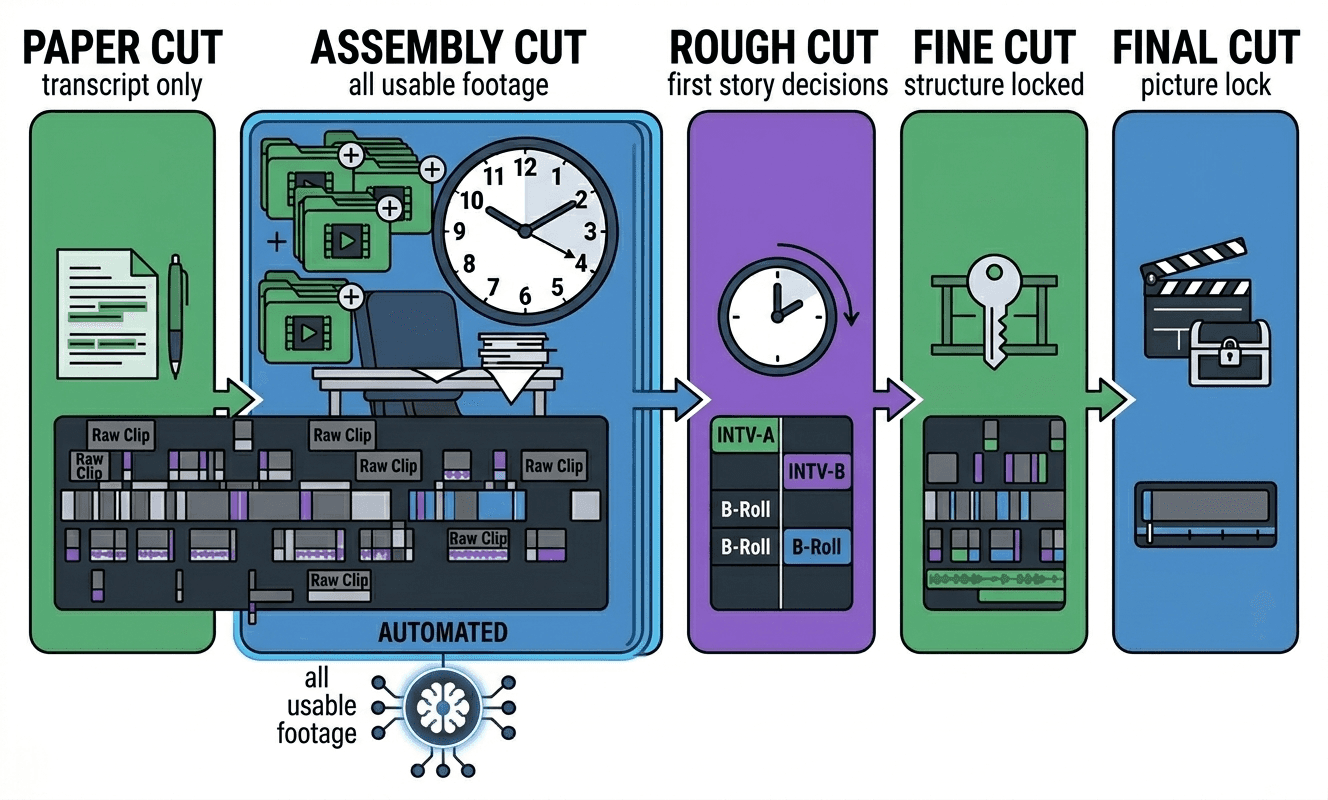
The assembly cut comes before the rough cut. It is the complete, unedited sequence of all usable footage laid down in order, no story decisions, no trimming for pace, just organized raw material. The rough cut is the first pass where those decisions are made. After the rough cut, the edit progresses to the fine cut, where pacing is tightened, transitions are refined, and the structure is locked. The fine cut is close to the final version but still open to adjustments before picture lock. Beyond that comes the final cut (or picture lock), after which no further editorial changes are made, and the project moves into sound design, color grading, and delivery. The full progression is: paper cut → assembly cut → rough cut → fine cut → final cut, each stage narrowing the edit closer to its finished form.
Where Does the Paper Cut Fit In?
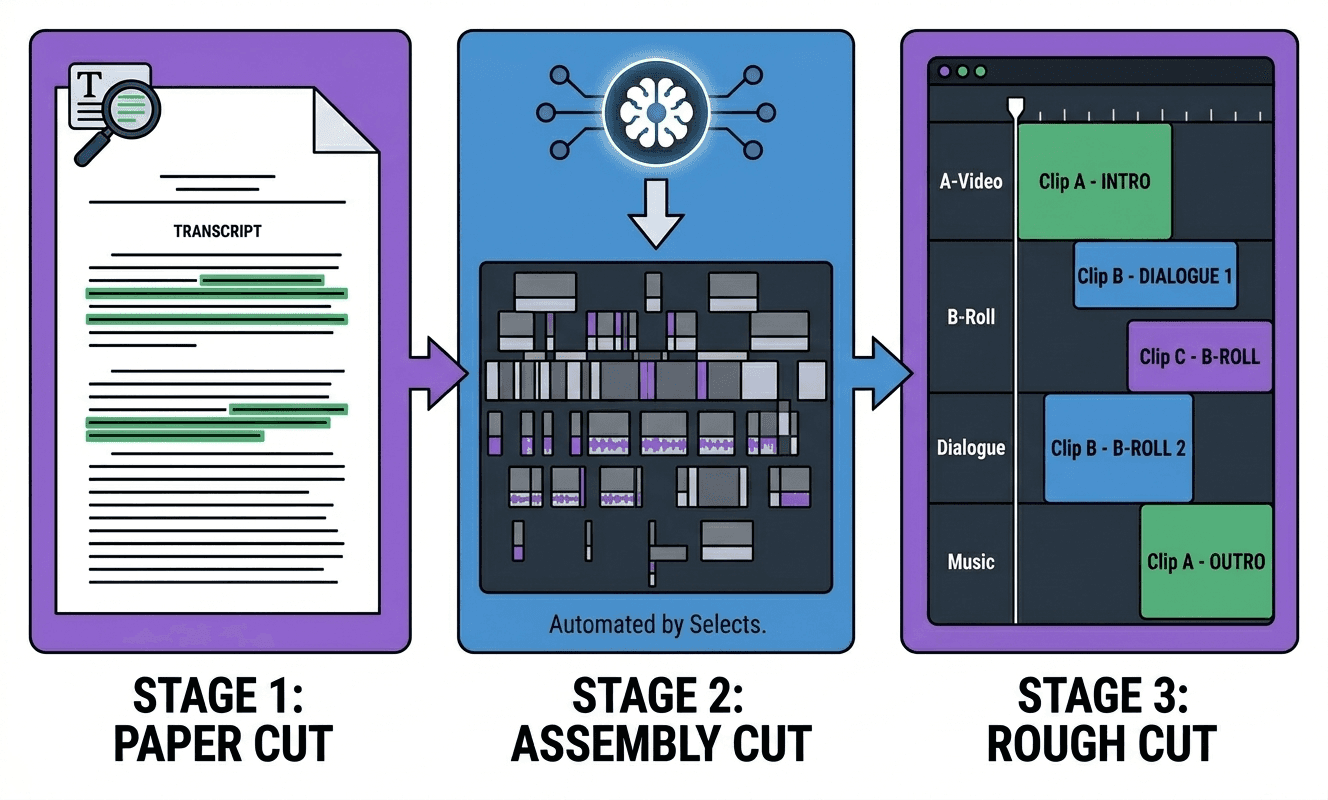
The paper cut is a stage used primarily in documentary and long-form editorial work. Before any footage is touched, an editor (or producer) builds the structure of the edit on paper, using only the transcript. Sections are selected, ordered, and refined as text before a single clip is moved on the timeline.
The paper cut sits between pre-production and the assembly cut. It's the blueprint that the assembly cut is built from.
In modern workflows, video chunking serves a similar function, breaking long recordings into labeled segments before editing begins, so the editor arrives at the assembly stage with a map rather than a mountain of unstructured footage.
The five editorial stages at a glance:
Paper cut — structure decided on transcript before touching footage
Assembly cut — all usable footage laid down in sequence, no story decisions
Rough cut — first round of story and pacing decisions
Fine cut — structure locked, pacing tightened, close to final
Final cut / picture lock — no further editorial changes, moves to post
The Goal of the Assembly Cut: Why the Assembly Stage Is Where Most Editing Time Is Lost
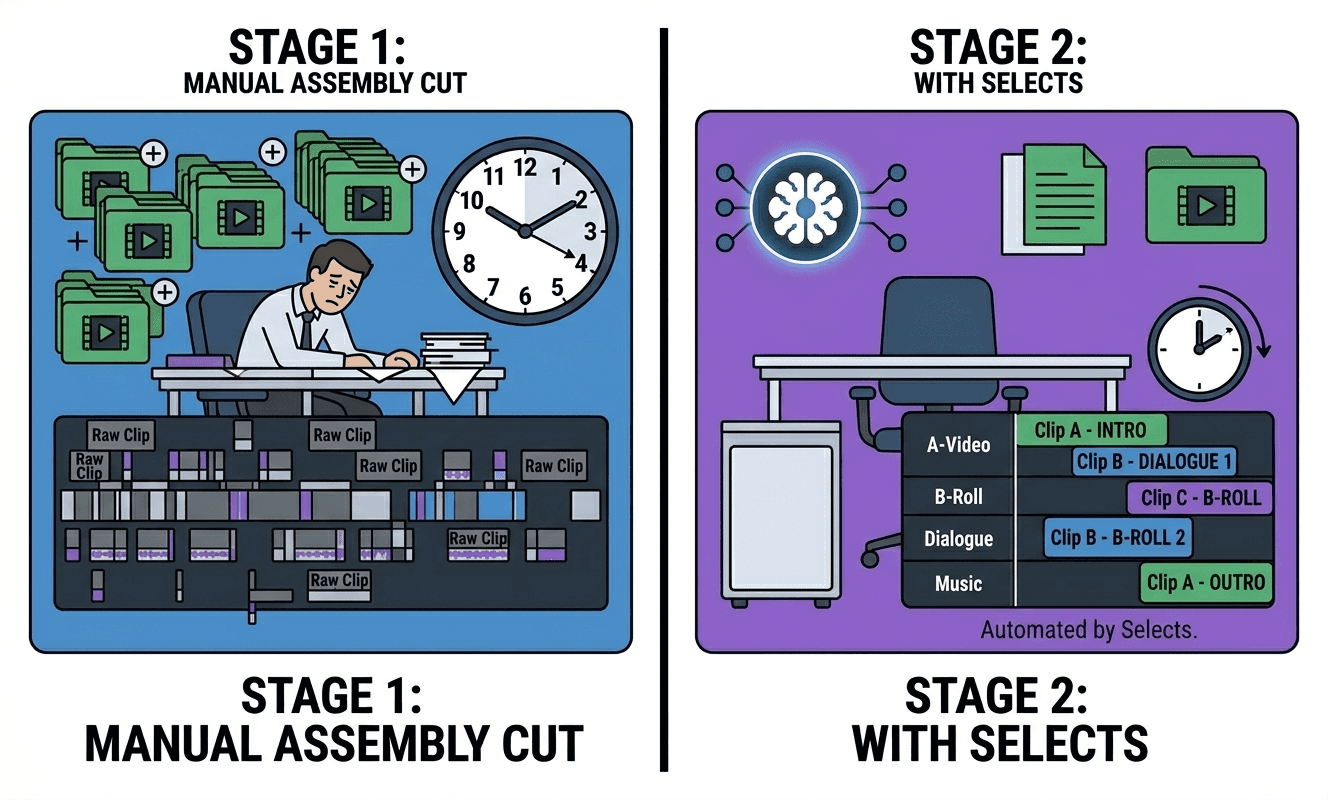
The assembly cut is mechanical work. Syncing cameras, labeling speakers, pulling selects from hours of raw footage, and building a continuous sequence, none of it requires creative judgment, but all of it takes significant time.
For a one-hour podcast with two cameras and external audio, the assembly stage alone typically runs three to five hours. For a documentary or long-form interview series, it can be days. And it happens on every single project, every single time, before the editor makes a single creative decision.
This is the core inefficiency in long-form editing workflows. The work that requires the least skill consumes the most time, leaving editors with less capacity for the work that actually requires them.
The stringout and selects process is where this time is traditionally spent, building the organized sequence of usable material that the assembly cut is constructed from. It's the most automatable stage of editing, and historically the least automated.
How Selects Automates the Assembly Cut as an AI Pre-Editing Tool
Selects is a standalone AI pre-editing tool built specifically to handle the assembly stage. It’s currently the best tool to automate assembly cuts with agentic video editing on the market. Here's what happens when you use it:
Upload your raw footage: Drop in your files, single cam, multicam, with external audio. Selects ingests everything.
Automated analysis: Selects, transcribes the audio, detects and labels speakers, identifies silences and filler words, and organizes content into topic-based chapters. It reads your footage the way an assistant editor would, systematically, without skipping anything.
Stringout and assembly cut: Based on that analysis, Selects builds a structured sequence of usable material. Silences and unusable takes are removed. If you're working with multicam footage, camera angles are switched by speaker.
NLE handoff: The resulting assembly exports directly to Adobe Premiere Pro, Final Cut Pro, or DaVinci Resolve, color-coded, labeled, with markers and transcripts included. The editor opens their NLE at the rough cut stage, not at raw footage.
The assembly cut, the stage that typically consumes the first hours of every long-form project, is handled before you open your editing software.
What Editors Do With the Time Saved
When the assembly stage is automated, editors start every project at the rough cut. The mechanical work is already done. The creative work is what remains.
In practice, that means:
More time on narrative structure and pacing decisions
More capacity for client projects without proportional headcount growth
Faster turnaround without compromising the quality of editorial judgment
The energy-intensive creative work happens when editors are fresh, not after hours of prep
For YouTube studios running regular long-form content, podcast agencies managing multiple clients, and in-house teams where one editor is doing three jobs, the assembly stage is where the most time is available to recover. Automating it doesn't change how you edit. It changes where you start.
FAQ
Q: What comes first, the assembly cut or the rough cut? A: The assembly cut comes first. It is the complete first pass of all usable footage laid down in sequence order with no story decisions made. The rough cut follows; it is the first edit where creative decisions about structure, pacing, and content are applied to the assembly.
Q: What is a paper cut in editing? A: A paper cut is a pre-editing stage used in documentary and long-form work where the editor builds the structure of the edit using only the transcript, selecting and ordering content on paper before touching any footage. It functions as a blueprint for the assembly cut and is particularly useful for projects with large amounts of interview or dialogue-heavy material.
Q: Can AI create an assembly cut automatically? A: Yes. Selects by Cutback automates the assembly cut stage. It ingests raw footage, transcribes audio, detects speakers, removes silences and unusable takes, organizes content by topic, and exports a structured, labeled timeline directly to Premiere Pro, Final Cut Pro, or DaVinci Resolve. The editor receives a complete assembly cut without manually building it from raw files.
Q: Is Selects worth it for editors who work with long-form interview or podcast content regularly? A: For editors working with long-form footage on a regular basis, Selects recovers the hours spent on assembly for every single project. The assembly stage for a one-hour recording typically runs three to five hours manually. Selects handles it automatically before the editor opens their NLE. For agencies managing multiple projects per week, the time savings compound significantly across client volume.

Kay Sesoko
Marketer
Share post